We read the whole category before we built anything
Ten platforms compared feature by feature, fourteen Indian vendors and eighteen United States vendors reviewed, and every claim labelled by how well it is sourced. This page is the short version of what that turned up — including the parts that flatter the incumbents.
- 10
- platforms compared
- 14 + 18
- India + US vendors
- Labelled
- verified · reported · judgment
Each of them owns a piece. Nobody holds the whole record.
Static out-of-home, digital screens and the print run that feeds the static half are one business — and they are sold as three products with three logins, three rate cards and three copies of the same client.
Three tools for one business
Availability, rates, clients and invoices get duplicated across the tools, and drift apart the moment they are.
Discovery, not delivery
Most Indian platforms in the survey generate the enquiry. Very few of them actually transact the booking.
The money layer sits untouched
Long receivables are the industry's own most-cited pain — and nothing in the survey is sold against it.
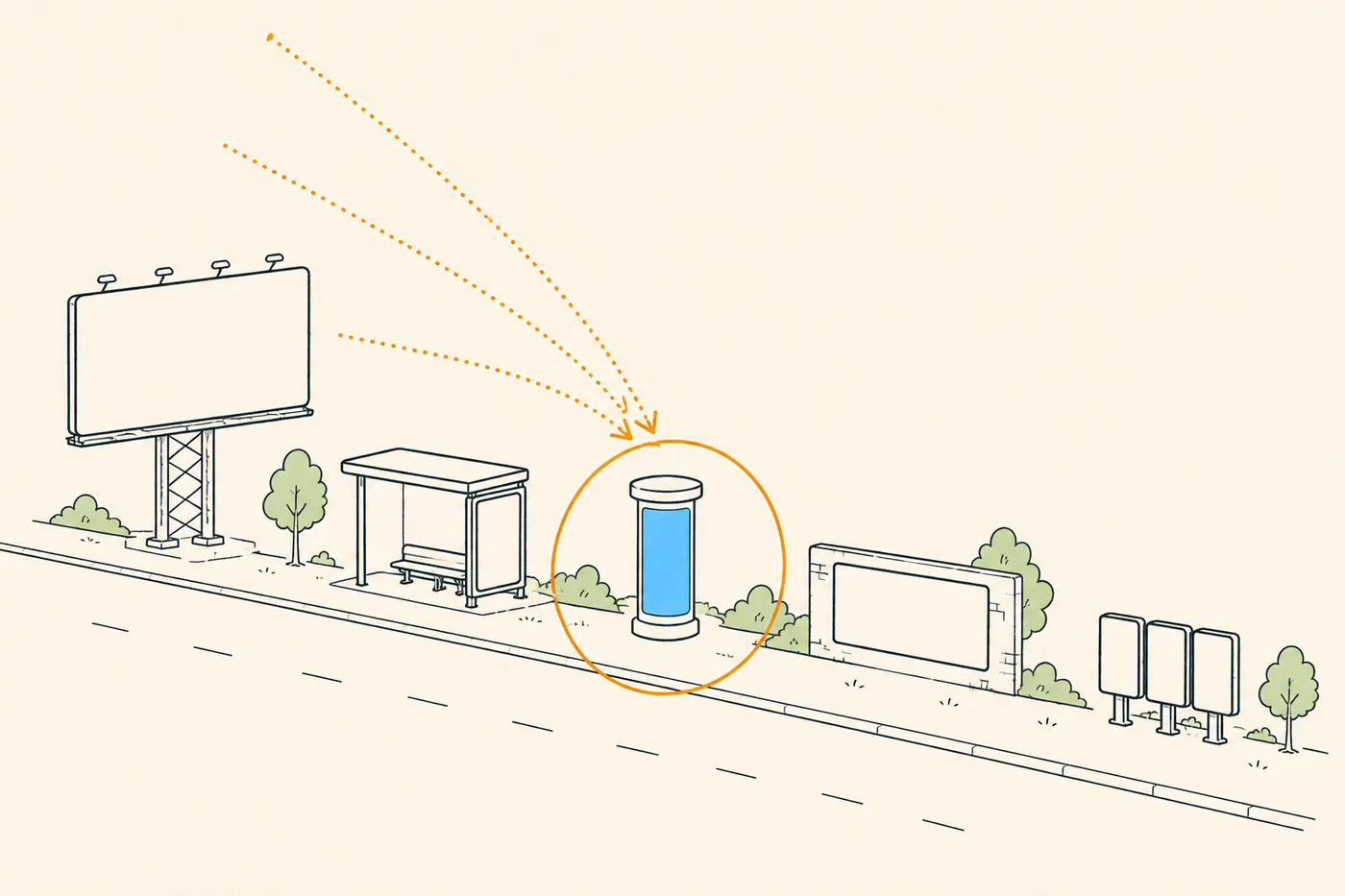
What the leaders own — and what they leave open
Read this as respect, not as a takedown. Each of these is genuinely good at the thing it was built for. The gaps below are the ones our own survey could not find published anywhere.
They own aggregation and measurement — self-serve and managed buying running side by side, with real audience data behind the plan. What they are not is an Indian tax or compliance product, and nothing in them covers print or municipal permits. Their entry-level spend also puts them out of reach of the buyer we are built for.
The best-documented plumbing in the industry — screen serving, exchanges, dynamic creative and availability semantics done properly. They are digital-only by design: no static out-of-home operations, no field crews, no production, and finance stays in the media owner's own accounting system.
Inventory, operations and plan exports, and the one vendor in our survey that names both GST and withholding tax. Its legal invoice is still produced downstream in a separate accounting package, and we could not find e-invoicing, the release order as a document, or a published permission model anywhere on its public surface.
Real screen inventory and real programmatic demand, and the ones actually moving digital out-of-home forward here. They are digital-only, and at least one prices close to parity with global rates — which is precisely the opening a domestic entrant walks through.
Genuinely useful for discovery and for generating an enquiry. In our survey only one of them actually transacts — a calendar, a multi-city cart and an instant confirmation. For the rest, the booking still happens on a phone call afterwards.
Six things our survey could not find published anywhere
Each of these was checked twice across the same set of vendors. Where something is absent, we say only that it was not published by the vendors we surveyed — not that it does not exist.
Permits as a booking constraint
Municipal permits, licence renewals and structural certificates as dates on the site record — with a lapsed date blocking the sale, not sitting in a folder.
E-invoicing as a first-class document
An invoice built to clear the country's own e-invoicing pipeline, rather than exported to be re-keyed somewhere else.
The release order as a real document
Indian out-of-home contracts on a release order. It is how the buy is actually agreed, and it is almost never modelled as a document.
Authenticity controls on the proof photo
Plenty of platforms require a photograph. We could not find one that publishes how it checks the photograph it requires.
Receivables as a headline capability
The industry's worst pain, named by the industry itself — and nothing in the survey is sold as the answer to it.
Static, digital, print and finance in one record
The reason the other five are even possible. Hold them together, and the compliance, the tax and the proof all have somewhere to live.
“We built the thing we could demonstrate — the photograph — when what the customer buys is the thing that settles an argument with their counterparty.”
The correction that shaped this product, from our own review of our earlier work

The campaign that is too small for a marketplace and too big for a phone call
The mid-size local buyer — the D2C launch, the regional franchise, the clinic opening its second branch — is invisible to the platforms with a large minimum spend, and badly served by the ones that only generate an enquiry.
The easiest site to book gets booked, because there is no tool that spreads the same budget across formats and localities and shows the reasoning.
A photograph arrives in a chat thread. It might be the right board, the right week and the right creative — and there is no way to tell.
Without a proof pack attached to the booking, a dispute is settled by whoever is more persistent rather than by the record.
Say the budget and the goal. Get the mix with its reasoning, the photographs checked before you see them, and one invoice at the end.
Planning first, proof second
The mix is what you pay for. The photograph is what makes the mix believable — in that order, on every page we write.
India first, built for two regimes
Documents, tax and booking grain are configuration, not code — so the United States is a second regime of the same product.
Honest about what is not built
We are pre-launch. Where something is coming rather than shipped, this site says coming.
- Sourced, not asserted
- Claims we can defend
- No invented numbers
- India first
Built on what the market is missing, not on what demos well
Be in the first group
Nukkad opens city by city. Tell us who you are and where you buy, and we'll bring you in when your city goes live.