AI you can name, not AI you have to take on trust
Out-of-home is full of software that says 'AI-powered' and stops there. Nukkad ships eighteen engines instead, and every one of them has a name, a job, an input, an output and a limit we will tell you about before you ask.

- 18 engines
- each one named
- 4 waves
- deterministic first
- Human
- makes the final call
What an engine has to be able to say before we ship it
If an engine cannot answer all four, it does not go into the product and it does not go into our copy.
It has a name and a job
Not 'AI-powered planning' — an engine called Zone Planner that answers one question you can repeat back.
It has an input and an output
You can see what went in and what came out, on the screen where the decision gets made.
It states its confidence
A number the engine is unsure about is presented as unsure, not rounded up into certainty.
A person decides
Every engine proposes. Nothing that matters is approved, rejected or billed without a human.
The boring engines ship first, on purpose
A geofence check that always works beats a language model that usually does — and the deterministic wave is what makes the later engines' training data worth trusting.
Wave 1 — deterministic
Geo Sentinel, Duplicate Guard, Site Code Reader and SLA Watchdog. No model risk, immediate value.
Wave 2 — the spine
Proof Vision, Route Optimiser, Report Narrator and Proposal Composer — the everyday work.
Wave 3 — the difference
Rate Advisor, Occupancy Forecaster, Zone Planner and Dispute Triage — all run on data only Nukkad creates.
Wave 4 — table stakes
Brief-to-Plan, Inventory Q&A, Invoice Reader, Collections Signal, KYC Extractor, Assignment Matcher.
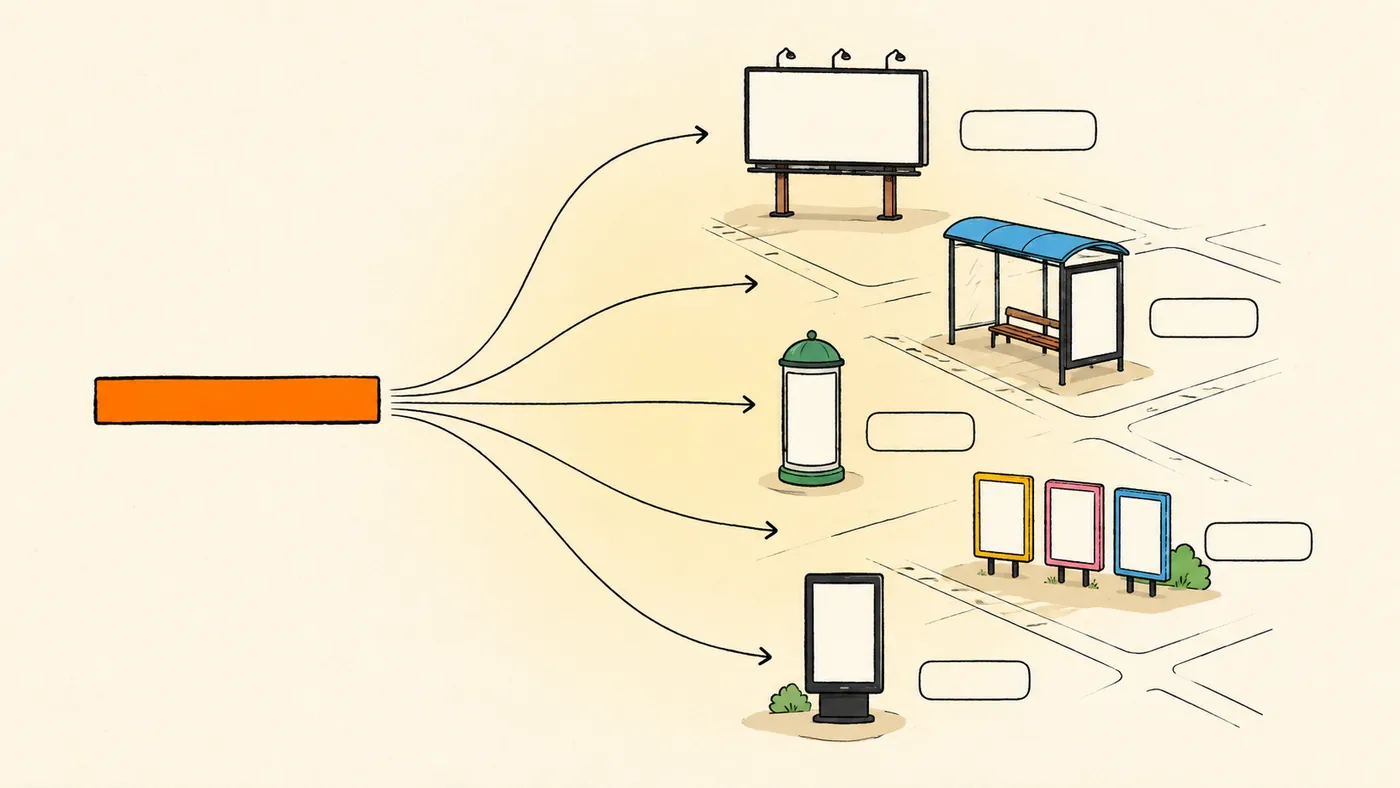
The engines that decide where the money goes
This is the part of the product a client actually pays more for — the mix, and the reason behind it.
- 01
Zone Planner
Given a budget and the zones you care about, which sites? A coverage optimiser with a proven approximation guarantee — and no language model involved.
- 02
Brief-to-Plan
A brief in plain language becomes a draft campaign. Every field is editable, because the draft is a starting point, not a verdict.
- 03
Rate Advisor
A suggested rate for a site, with the confidence band and the comparables it drew from shown next to it.
- 04
Occupancy Forecaster
How much of the estate is likely to sit empty next month — with intervals, so you can see how sure it is.
The engines that check the photograph
Proof is not the headline — planning is. But proof is what makes the plan believable, so these run on every single capture.
- 01
Geo Sentinel
Was this photograph really taken at that site, at that time? A trust score with the specific anomalies named.
- 02
Duplicate Guard
Have we seen this photograph before? Matched across the whole account, not just within one campaign.
- 03
Proof Vision
Is the poster up, is it ours, and is it intact? A verdict with reason codes and a confidence attached.
- 04
Site Code Reader
Reads the site plate from a framed, cropped shot and fills the field in — a full street scene is not attempted.
The engines that run the operation and the money
Less glamorous, and the ones an operations lead notices first when they are missing.
Route Optimiser
What order should this installer ride today? Classical operations research, not a guess.
Assignment Matcher
Which installer should get this job, weighted by proximity, capacity and past quality.
SLA Watchdog
Which campaigns are about to breach their proof deadline, and who needs nudging first.
Invoice Reader
A vendor invoice pre-fills the payable; anything it is unsure about is queued as an exception.
Collections Signal
Which invoices are about to go bad, and the order to chase them in.
Dispute Triage
Reads a complaint, gathers the evidence already on the record, and proposes a resolution to approve.
“We model audiences from traffic and location data. We do not put cameras on people.”
A standing rule in the product, not a privacy page nobody reads
What we will not claim, and why we say so up front
Every limit below is a real ceiling in the published state of the art. Designing around them is cheaper than apologising for them later.
Automated visual compliance is nowhere near perfect, and anyone claiming otherwise is describing a demo. Routine captures clear themselves; anything flagged goes to a person. That is the design, not a limitation we are working around.
Benchmark scores belong to the benchmark, not to our product. When we publish an accuracy number it will be ours, measured on our own held-out data, with the date it was measured.
There is no camera-based audience or demographic measurement in Nukkad in India, and no facial recognition anywhere in it. Audiences are modelled from traffic and location data, and labelled as modelled.
Natural language maps to filters you can see and correct — a question becomes a search you can check, never an answer you have to believe.
KYC documents are read to save typing. Approval is always a person's decision, and the record says whose.
Every uplift percentage we found published in this category came without a sample, a period or a control. We would rather show you the plan and the proof than quote someone else's number.
Every engine proposes
The engine's output arrives as a suggestion with its reasoning, on the screen where the decision is made.
A human disposes
Approvals, rejections and anything that bills are a person's call — and the record keeps who decided.
Overrides are watched
If people keep overriding an engine, that is the engine's problem to fix, and we track it as one.
- Named engines only
- Confidence shown
- Human in the loop
- No cameras on people
See the engines when we open the doors
Nukkad is launching soon. Join the waitlist and we'll show you the planner, the proof queue and the engine log on real inventory in your city.